Meeting Minutes Template with Decisions and Action Items
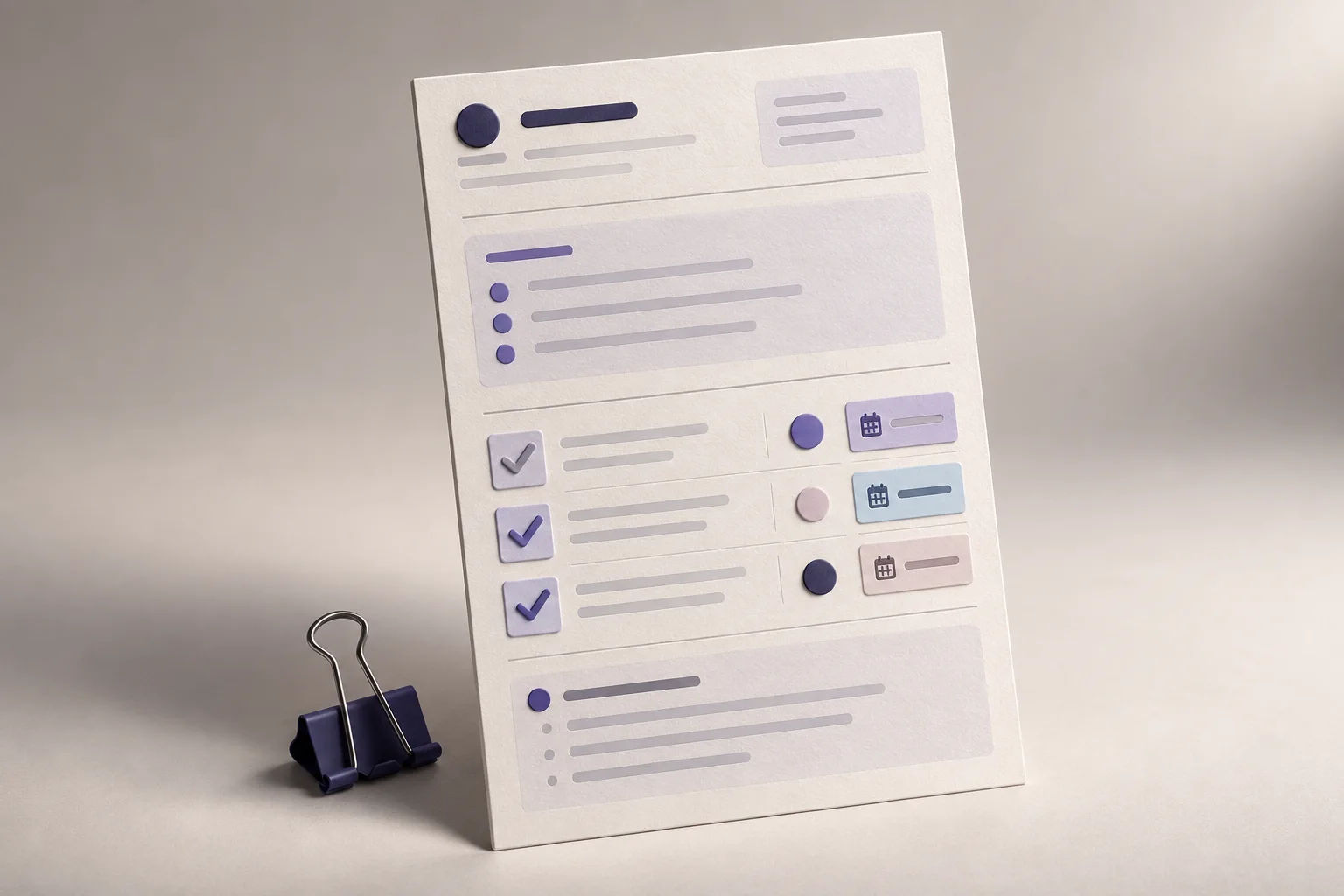
Copy the template below into Google Docs, Word, Notion, or your team workspace. It separates discussion from decisions and gives every action item an owner, due date, and status, so readers can understand the outcome without replaying the meeting.
Copyable meeting minutes template
# Meeting minutes: [Meeting name]

**Date and time:** [YYYY-MM-DD, start–end, time zone]
**Location or call link:** [Room or platform]
**Facilitator:** [Name]
**Minute-taker:** [Name]
**Attendees:** [Names]
**Absent / optional:** [Names]
**Objective:** [The outcome this meeting should produce]

## Executive summary

[Write 3–5 sentences covering the purpose, main outcome, and important constraint.]

## Agenda and outcomes

### 1. [Agenda item]

- **Context:** [Only the information needed to understand the outcome]
- **Decision:** [What was approved, rejected, or deferred]
- **Reason:** [Short rationale, when useful]
- **Open question:** [Unresolved issue, or “None”]

### 2. [Agenda item]

- **Context:**
- **Decision:**
- **Reason:**
- **Open question:**

## Decisions register

| ID | Decision | Decision owner | Date | Source / timestamp |
| --- | --- | --- | --- | --- |
| D-01 | [Complete decision statement] | [Name] | [YYYY-MM-DD] | [Link or time] |

## Action items

| ID | Action and deliverable | Owner | Due date | Status | Related decision |
| --- | --- | --- | --- | --- | --- |
| A-01 | [Verb + observable deliverable] | [One person] | [YYYY-MM-DD] | Open | D-01 |

## Risks and blockers

| Risk or blocker | Impact | Owner | Next review |
| --- | --- | --- | --- |
| [Issue] | [What it could delay or change] | [Name] | [YYYY-MM-DD] |

## Open questions

| Question | Person to answer | Due date | Where the answer will be recorded |
| --- | --- | --- | --- |
| [Question] | [Name] | [YYYY-MM-DD] | [Document or channel] |

## Follow-up

- **Minutes reviewer:** [Name]
- **Distribution:** [People or channel]
- **Final record:** [Link or folder]
- **Next meeting:** [Date, time, or “Not scheduled”]
Use Unconfirmed instead of leaving an important field blank. A visible gap is easier to resolve than a task with no owner or a decision with no approval state.
What each section is for
| Field | What to record | Avoid |
|---|---|---|
| Objective | One outcome the meeting should create | A broad topic such as “Discuss launch” |
| Executive summary | Outcome, key decision, and major constraint | A chronological transcript |
| Context | Facts needed to understand a decision | Side conversations and opinions |
| Decision | A complete statement of what was agreed | “Talked about pricing” |
| Action | Verb, deliverable, one owner, and due date | “Team to follow up” |
| Open question | What remains unknown and who will resolve it | Hiding unresolved items inside notes |
| Source | Recording timestamp, transcript section, or document | A link nobody can access |
If you need the full writing process rather than a reusable format, read how to write meeting minutes. If your source is a recording, start with how to transcribe a meeting.
Completed example: mobile onboarding planning
Date and time: October 7, 2026, 10:00–10:45 AM PT
Facilitator: Maya Chen
Minute-taker: Sam Brooks
Attendees: Maya Chen, Daniel Ortiz, Lena Hoffmann, Sam Brooks
Objective: Select the onboarding experiment for the November mobile release.
Executive summary
The team selected a guided checklist for a two-week onboarding experiment. It fits the November engineering window and will be shown to 50% of new users. First-transcript completion is the primary activation event. The interactive tutorial was deferred until the checklist results are reviewed.
Decisions register
| ID | Decision | Decision owner | Date | Source |
|---|---|---|---|---|
| D-01 | Run the guided-checklist experiment for two weeks with 50% of new users. | Maya | 2026-10-07 | 00:28:14 |
| D-02 | Measure activation by completion of the first transcript. | Maya | 2026-10-07 | 00:31:42 |
| D-03 | Exclude the interactive tutorial from the November release. | Lena | 2026-10-07 | 00:36:08 |
Action items
| ID | Action and deliverable | Owner | Due date | Status | Related decision |
|---|---|---|---|---|---|
| A-01 | Deliver the final checklist flow and empty states. | Daniel | 2026-10-12 | Open | D-01 |
| A-02 | Confirm analytics event names and experiment allocation. | Lena | 2026-10-13 | Open | D-01, D-02 |
| A-03 | Draft the in-app explanation for the test group. | Sam | 2026-10-14 | Open | D-01 |
| A-04 | Review launch readiness and approve release. | Maya | 2026-10-16 | Open | D-01–D-03 |
Open question
Should returning users who have never created a transcript enter the experiment? Maya and Lena will decide during the October 16 readiness review.
Notice that the example does not preserve every comment. It preserves the agreed record and enough context to verify what happens next.
Three useful variations
Simple team meeting
Use this for a short weekly sync:
Meeting / date:
Attendees:
Goal:

Decisions
-

Actions
- [Action] — [Owner] — [Due date]

Blockers
-

Next check-in:
Formal meeting
Add fields for meeting chair, quorum, motions, proposer, seconder, votes, conflicts of interest, approval, and signature only when your organization requires them. A generic business template is not a substitute for bylaws, board procedures, or legal requirements.
Action-focused meeting
Keep only the objective, decisions register, action table, blockers, and next review. This works well for project delivery, incident follow-up, and recurring operating meetings.
Turn a recording into this template
- Record or import the meeting with participants’ knowledge and according to the applicable policy.
- Generate a transcript with speaker labels when available.
- Extract candidate decisions, tasks, owners, deadlines, risks, and questions.
- Place each item in the matching section instead of summarizing the conversation chronologically.
- Compare names, dates, amounts, commitments, and disputed points with the source.
- Ask the responsible reviewer to approve the final record.
FastRekap can keep the recording, transcript, summary, and follow-up questions together while you prepare the draft. A person should still verify the final minutes, especially when a deadline, formal approval, or sensitive statement matters.
Common mistakes
| Mistake | Why it causes problems | Better approach |
|---|---|---|
| Mixing decisions into discussion notes | Readers cannot tell what was approved | Maintain a separate decisions register |
| Assigning a task to “the team” | Nobody has clear accountability | Name one owner and list contributors separately |
| Omitting the due date | The action cannot be reviewed reliably | Record a date or mark it Unconfirmed |
| Writing a transcript instead of minutes | Important outcomes become hard to find | Keep only essential context and link to the source |
| Publishing an AI draft without review | Names, numbers, or implied commitments may be wrong | Verify high-impact fields against the recording |
| Using an operational template for a formal board | Required motions or votes may be missing | Follow the organization’s governing rules |
Frequently asked questions
What is the difference between an agenda and meeting minutes?
The agenda describes what the group plans to discuss. Minutes record what actually happened: decisions, actions, owners, deadlines, and unresolved questions. Using the same headings for both makes the final record faster to complete.
Should minutes include every discussion point?
Usually not. Include only the context needed to understand an outcome. Use a transcript when exact wording or a detailed chronological record is required.
Can I copy this template into Word or Google Docs?
Yes. The template uses plain headings and tables so it can be pasted into most document and knowledge-management tools. Adjust the table formatting after pasting if your editor handles Markdown differently.
Who approves the minutes?
For routine meetings, the facilitator or decision owner is often sufficient. Boards, committees, and regulated organizations may have a formal approval process; follow those rules.
Can AI fill the template automatically?
AI can draft sections from a transcript, but a named reviewer should confirm decisions, ownership, dates, figures, and sensitive information before distribution.
Final review checklist
- [ ] The objective states the outcome the meeting needed.
- [ ] Decisions are separate from discussion notes.
- [ ] Every action starts with a verb and names one owner.
- [ ] Every action has a due date or an explicit
Unconfirmedmarker. - [ ] Risks and open questions have owners and review dates.
- [ ] Names, dates, figures, links, and source timestamps were checked.
- [ ] The reviewer, distribution list, and final storage location are clear.